> ## Documentation Index
> Fetch the complete documentation index at: https://docs.sequencehq.com/llms.txt
> Use this file to discover all available pages before exploring further.
# Multi-entity support
> Run quoting and billing across separate legal entities
Multi-entity support lets finance and revenue teams run quoting and billing for separate legal entities. Each entity keeps its own customers, quotes, billing schedules, invoices, and integrations.
 ## Switch workspace
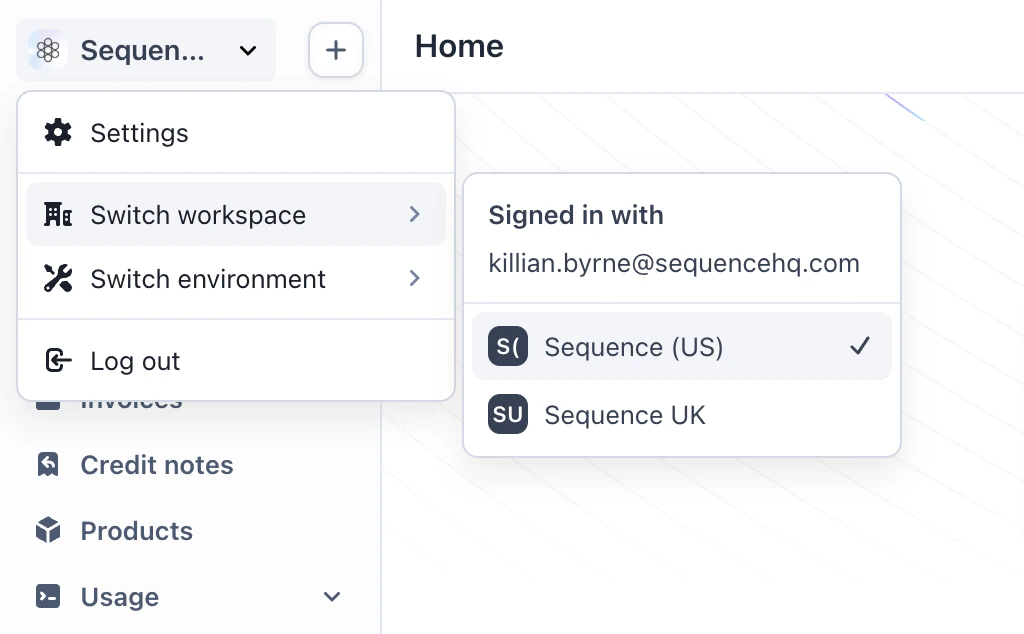
Open the workspace menu in the top-left of the dashboard and select **Switch workspace** to move between legal entities. Customers, quotes, billing schedules, invoices, and user access stay scoped to the entity you are working in.
Use this when you operate more than one legal entity or business unit that should not share billing data.
Additional entities are available at an additional cost. Reach out to the Sequence team to add more entities to your account.
## Quoting by entity
Quotes are created and managed within the active entity. Product catalog, pricing, and deal terms apply to that entity only, so sales teams issue proposals under the correct legal entity.
For quote creation and lifecycle, see [Create quotes](/cpq/create-quotes).
## Billing and invoices by entity
Billing schedules, draft invoices, and sent invoices belong to the active entity. Merchant details, tax registrations, payment collection, and invoice branding apply to invoices issued from that entity.
For invoice workflows, see [Invoicing customers](/invoicing/invoicing-customers).
## Approval workflows by entity
[Workflows](/agents/workflows) run within the active entity. Quote approvals, contract intake, and other review steps route to the right team for that entity. Tasks in [Watchtower](/agents/watchtower) only include work for the entity you are signed into.
## ERP and accounting sync
Connect each entity to the accounting or ERP instance it should use. Entities can sync to separate instances, such as different Xero organizations or QuickBooks companies, or share one instance when your finance setup allows.
For supported accounting integrations and sync behavior, see [Accounting and ERP overview](/integrations/accounting-overview).
## Switch environment
Select **Switch environment** to move between sandbox and production. Use sandbox to test quoting, billing runs, and integrations. Use production for live customer billing.
**Sandbox**: `https://dashboard.sandbox.sequencehq.com`
## Switch workspace
Open the workspace menu in the top-left of the dashboard and select **Switch workspace** to move between legal entities. Customers, quotes, billing schedules, invoices, and user access stay scoped to the entity you are working in.
Use this when you operate more than one legal entity or business unit that should not share billing data.
Additional entities are available at an additional cost. Reach out to the Sequence team to add more entities to your account.
## Quoting by entity
Quotes are created and managed within the active entity. Product catalog, pricing, and deal terms apply to that entity only, so sales teams issue proposals under the correct legal entity.
For quote creation and lifecycle, see [Create quotes](/cpq/create-quotes).
## Billing and invoices by entity
Billing schedules, draft invoices, and sent invoices belong to the active entity. Merchant details, tax registrations, payment collection, and invoice branding apply to invoices issued from that entity.
For invoice workflows, see [Invoicing customers](/invoicing/invoicing-customers).
## Approval workflows by entity
[Workflows](/agents/workflows) run within the active entity. Quote approvals, contract intake, and other review steps route to the right team for that entity. Tasks in [Watchtower](/agents/watchtower) only include work for the entity you are signed into.
## ERP and accounting sync
Connect each entity to the accounting or ERP instance it should use. Entities can sync to separate instances, such as different Xero organizations or QuickBooks companies, or share one instance when your finance setup allows.
For supported accounting integrations and sync behavior, see [Accounting and ERP overview](/integrations/accounting-overview).
## Switch environment
Select **Switch environment** to move between sandbox and production. Use sandbox to test quoting, billing runs, and integrations. Use production for live customer billing.
**Sandbox**: `https://dashboard.sandbox.sequencehq.com`
**Production**: `https://dashboard.sequencehq.com`
For rollout steps, see [Onboarding](/getting-started/onboarding).
## Entity settings
Open **Settings** from the workspace menu to configure merchant details, tax registrations, payment collection, and invoice branding for the active entity. Integrations that depend on merchant address or currency use these settings.
## Access across entities
[Roles & permissions](/users/roles-permissions) control what users can see and do within each workspace. Assign roles per workspace so teams only access the entities they need.