> ## Documentation Index
> Fetch the complete documentation index at: https://docs.sequencehq.com/llms.txt
> Use this file to discover all available pages before exploring further.
# Overview
> Streamline your month end process with automated journal reports
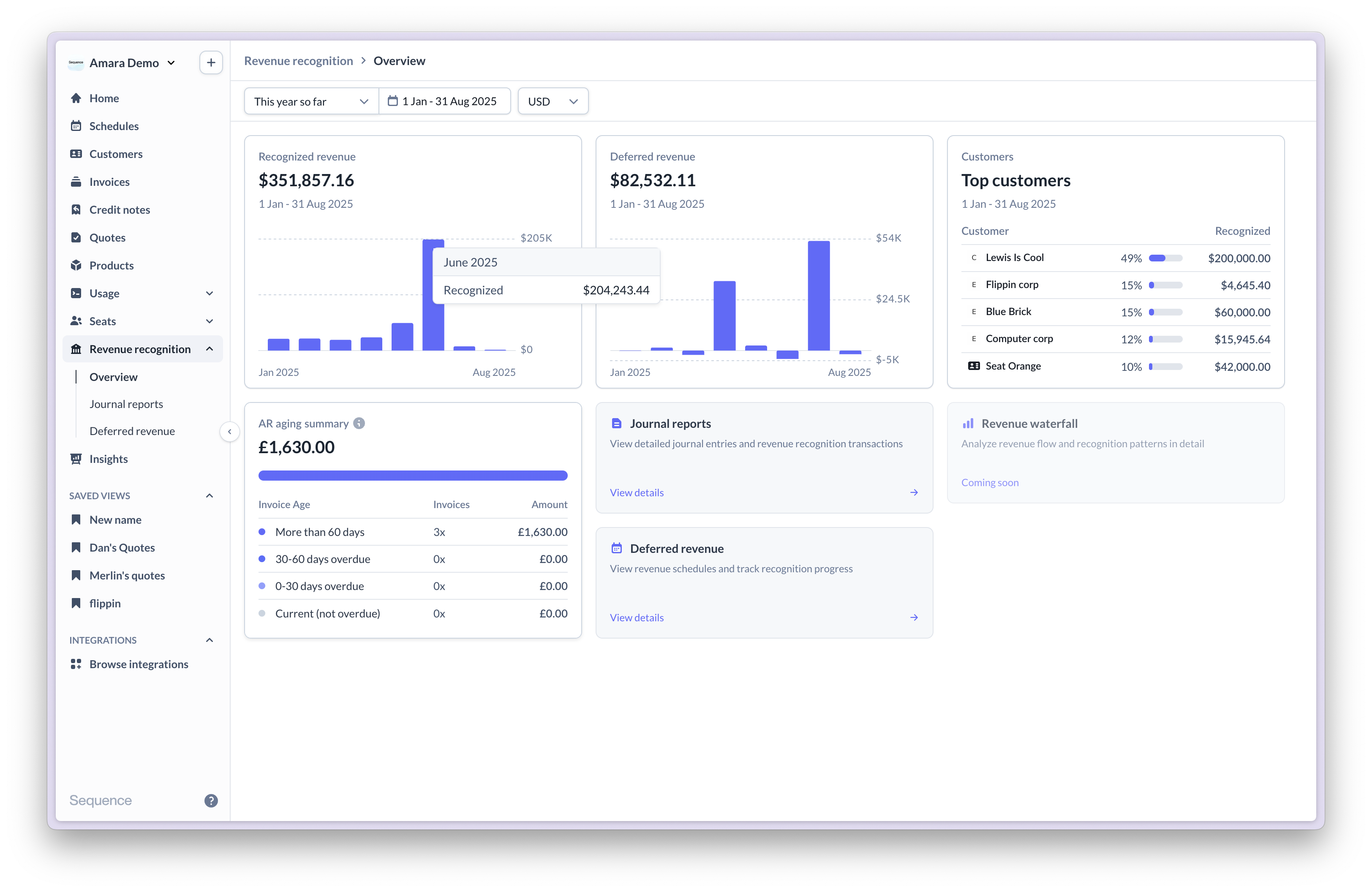
 Sequence's revenue recognition module produces the journals that move billed amounts into recognized revenue across the service period. The primary output is a monthly journal report you can post directly into your general ledger.
Reports can be customized in granularity and format to match your accounting conventions and downstream system.
Sequence's revenue recognition module produces the journals that move billed amounts into recognized revenue across the service period. The primary output is a monthly journal report you can post directly into your general ledger.
Reports can be customized in granularity and format to match your accounting conventions and downstream system.
 Sequence implements revenue recognition in line with ASC 606 (US GAAP) and IFRS 15 (IFRS), with equivalent treatment under FRS 102 §23 for UK SMEs.
## Key concepts
**In-advance and in-arrears billing**
Revenue recognition distinguishes between when customers are billed and when revenue is earned:
* **In-advance billing**: customers are charged upfront and revenue is recognized over time as services are delivered (e.g., annual subscriptions paid upfront).
* **In-arrears billing**: services are delivered first and billed afterwards, with revenue recognized as services are delivered (e.g., monthly usage-based billing).
**Recognition methods**
Sequence supports four recognition methods:
* **Straight-line**: Revenue divided evenly across the service period (most common).
* **Usage-based**: Revenue recognized based on actual usage each period.
* **Point-in-time**: Full amount recognized on a specific date (e.g., implementation fees).
* **Milestone**: Revenue recognized only when milestones are marked as complete.
For straight-line specifically, you can choose between three **allocation strategies**, which differ only in how the part-months at the start and end of a contract are prorated. See [Recognition methods](/revenue-recognition/recognition-methods#allocation-methods) and [Settings](/revenue-recognition/settings#allocation-strategy).
**Revenue accounts**
Sequence tracks revenue through four main accounts:
* **Billed Revenue**: Amounts invoiced to customers.
* **Recognized Revenue**: Revenue earned through service delivery.
* **Deferred Revenue**: Invoiced amounts not yet earned (for advance billing).
* **Unbilled Revenue**: Earned revenue not yet invoiced (for arrears billing).
**Account period locking**
Once a month is closed, Sequence can prevent any further journals from posting into it. Two methods are supported: lock against each invoice's accounting date, or set a single fixed lock date for the whole account. See [Settings](/revenue-recognition/settings#account-period-locking).
**Credit note behaviour**
Credit notes either **cancel** future obligations or **adjust** previously recognized revenue, depending on a per-account setting. The two modes produce visibly different journals. See [Credit notes](/revenue-recognition/credit-notes) for the trade-off and worked examples.
**Credit grants**
Prepaid credit grants reduce recognized revenue as they're consumed, so revenue isn't double-counted when an invoice is settled by a grant balance. See [Credit grants](/revenue-recognition/credit-grants).
## Frequently asked questions
* **Straight-line**: subscriptions and fixed-fee services delivered evenly over time.
* **Usage-based**: API usage, data processing, consumption billing.
* **Point-in-time**: setup fees, implementation services, one-off deliverables.
* **Milestone**: project work with specific deliverables tied to acceptance.
Product-level discounts are netted against the product's price within the same journal entry. A \$1,200 subscription with a \$120 discount generates one journal for the net \$1,080.
Invoice-level discounts are allocated across line items in proportion to each line's list price. Each line then recognizes its net amount on its own schedule.
Yes. Account period locking prevents new journals from posting into a closed month. Use each invoice's accounting date as its lock floor, or set a single custom lock date for the whole account. Invoices and credit notes can still be issued for locked periods; they post their revenue against the next open period. See [Settings](/revenue-recognition/settings#account-period-locking).
A credit grant represents revenue that has already been recognized at the point the grant was booked. When the grant is consumed against a subsequent invoice, the recognized revenue for that invoice is reduced by the consumed amount so revenue is not recognized twice. See [Credit grants](/revenue-recognition/credit-grants).
Sequence implements revenue recognition in line with ASC 606 (US GAAP) and IFRS 15 (IFRS), with equivalent treatment under FRS 102 §23 for UK SMEs.
## Key concepts
**In-advance and in-arrears billing**
Revenue recognition distinguishes between when customers are billed and when revenue is earned:
* **In-advance billing**: customers are charged upfront and revenue is recognized over time as services are delivered (e.g., annual subscriptions paid upfront).
* **In-arrears billing**: services are delivered first and billed afterwards, with revenue recognized as services are delivered (e.g., monthly usage-based billing).
**Recognition methods**
Sequence supports four recognition methods:
* **Straight-line**: Revenue divided evenly across the service period (most common).
* **Usage-based**: Revenue recognized based on actual usage each period.
* **Point-in-time**: Full amount recognized on a specific date (e.g., implementation fees).
* **Milestone**: Revenue recognized only when milestones are marked as complete.
For straight-line specifically, you can choose between three **allocation strategies**, which differ only in how the part-months at the start and end of a contract are prorated. See [Recognition methods](/revenue-recognition/recognition-methods#allocation-methods) and [Settings](/revenue-recognition/settings#allocation-strategy).
**Revenue accounts**
Sequence tracks revenue through four main accounts:
* **Billed Revenue**: Amounts invoiced to customers.
* **Recognized Revenue**: Revenue earned through service delivery.
* **Deferred Revenue**: Invoiced amounts not yet earned (for advance billing).
* **Unbilled Revenue**: Earned revenue not yet invoiced (for arrears billing).
**Account period locking**
Once a month is closed, Sequence can prevent any further journals from posting into it. Two methods are supported: lock against each invoice's accounting date, or set a single fixed lock date for the whole account. See [Settings](/revenue-recognition/settings#account-period-locking).
**Credit note behaviour**
Credit notes either **cancel** future obligations or **adjust** previously recognized revenue, depending on a per-account setting. The two modes produce visibly different journals. See [Credit notes](/revenue-recognition/credit-notes) for the trade-off and worked examples.
**Credit grants**
Prepaid credit grants reduce recognized revenue as they're consumed, so revenue isn't double-counted when an invoice is settled by a grant balance. See [Credit grants](/revenue-recognition/credit-grants).
## Frequently asked questions
* **Straight-line**: subscriptions and fixed-fee services delivered evenly over time.
* **Usage-based**: API usage, data processing, consumption billing.
* **Point-in-time**: setup fees, implementation services, one-off deliverables.
* **Milestone**: project work with specific deliverables tied to acceptance.
Product-level discounts are netted against the product's price within the same journal entry. A \$1,200 subscription with a \$120 discount generates one journal for the net \$1,080.
Invoice-level discounts are allocated across line items in proportion to each line's list price. Each line then recognizes its net amount on its own schedule.
Yes. Account period locking prevents new journals from posting into a closed month. Use each invoice's accounting date as its lock floor, or set a single custom lock date for the whole account. Invoices and credit notes can still be issued for locked periods; they post their revenue against the next open period. See [Settings](/revenue-recognition/settings#account-period-locking).
A credit grant represents revenue that has already been recognized at the point the grant was booked. When the grant is consumed against a subsequent invoice, the recognized revenue for that invoice is reduced by the consumed amount so revenue is not recognized twice. See [Credit grants](/revenue-recognition/credit-grants).