> ## Documentation Index
> Fetch the complete documentation index at: https://docs.sequencehq.com/llms.txt
> Use this file to discover all available pages before exploring further.
# Use-cases
> Handle discounts, credit notes, one-time invoices, and minimum fees
Revenue recognition handles complex billing scenarios automatically. This guide covers discounts, credit notes, one-time invoices, and minimum fees.
## Discounts
Discounts reduce the transaction price according to ASC 606/IFRS 15 guidelines. Sequence supports two types of discounts with different recognition treatments.
### Product-level discounts
Product-level discounts appear as negative line items within an existing line item group. They're netted against the product's price and recognized using the same method and service period.
**Example**: \$1,200 annual subscription with 10% discount
* Standard price: \$1,200
* Discount: -\$120 (within same line group)
* **Net recognition**: \$1,080 over 12 months using straight-line method
**Scenario**
* **Product**: Annual subscription service
* **Standard price**: \$1,200
* **Product-level discount**: 10% (-\$120)
* **Net amount**: \$1,080
* **Billing**: Annual in advance
* **Service period**: July 1, 2024 - June 30, 2025 (365 days)
* **Recognition method**: Straight-line
**Revenue recognition pattern**:
* **On invoice date** (July 1, 2024): Net amount deferred
* Journal: Debit Billed Revenue (+\$1,080), Credit Deferred Revenue (+\$1,080)
* **Daily recognition**: Revenue recognized based on actual days in each month
* Base daily amount: \$2.96 per day (\$1,080 ÷ 365 days)
* Most days: \$2.90 recognized daily
* Month-end adjustments: \$3.00 on final day to ensure monthly total of \$90
* Example for May 2025: 30 days × \$2.90 + 1 day × \$3.00 = \$90.00
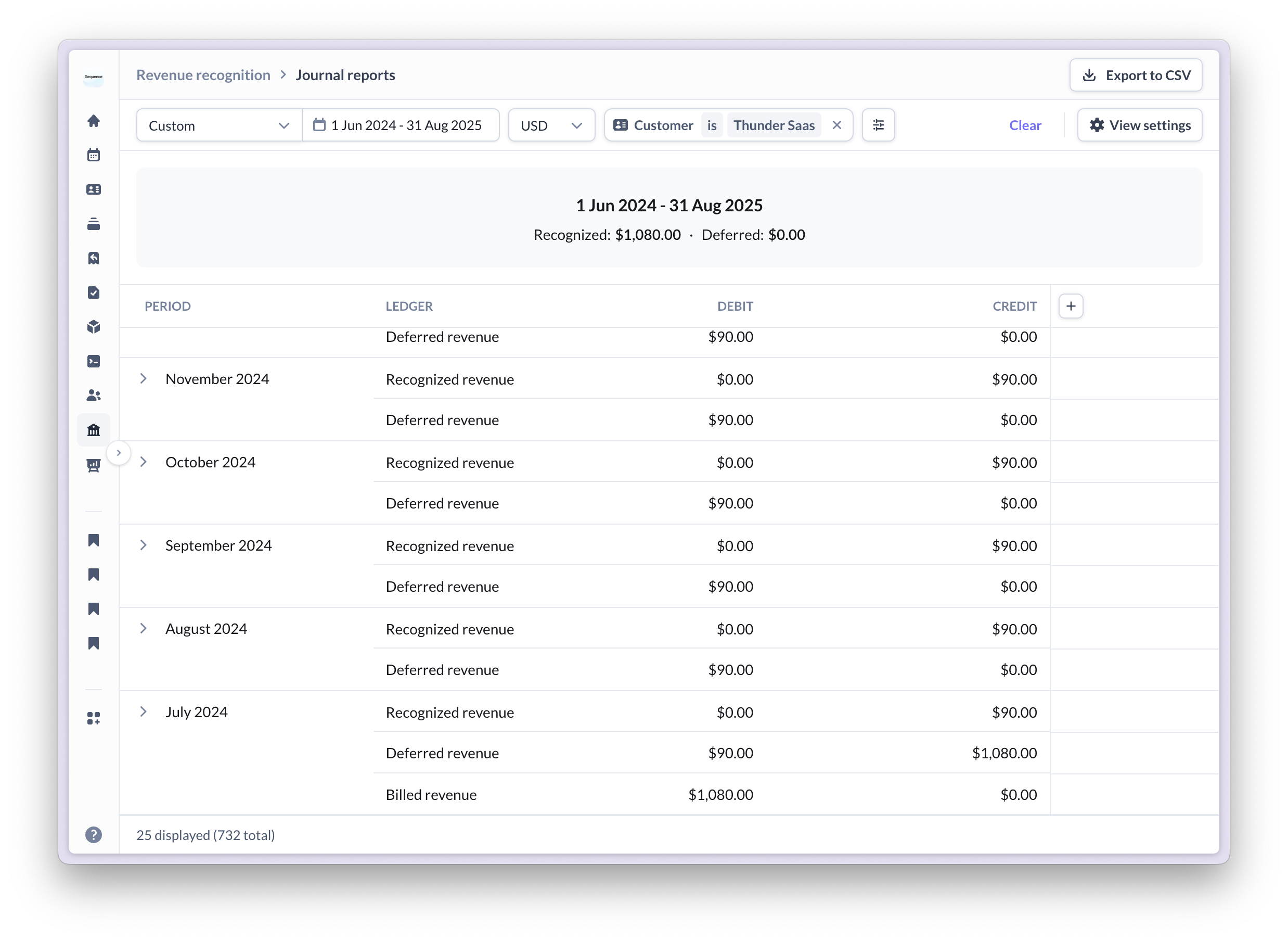 Product-level discounts are netted against the product price and recognized using the same method and timing as the underlying product.
### Invoice-level discounts
Invoice-level (global) discounts are separate line item groups with negative amounts. Sequence automatically allocates these discounts pro-rata across all invoice line items based on their standalone selling price.
**Example**: \$1,000 total invoice with \$100 global discount
* Line 1: \$800 subscription (gets \$80 discount allocation)
* Line 2: \$200 setup fee (gets \$20 discount allocation)
* **Recognition**: Each line recognizes its reduced amount using its own recognition method
Allocation is based on standalone selling price (SSP) - the transaction price of each line item - ensuring compliance with ASC 606/IFRS 15 standards.
This allocation happens automatically on the invoice date, so each line item's revenue schedule reflects the discounted amount.
## Credit notes
Credit notes reverse previously recognized revenue. The exact behaviour depends on the credit note variant (invoice-attached, direct, schedule-correction, or standalone) and on the account-level **revenue impact mode** (cancellation or adjustment). See [Credit notes](/revenue-recognition/credit-notes) for the full treatment with worked examples.
**Quick summary**:
* In **cancellation mode** (default), the credit note removes future obligations and reverses the deferred balance, before touching recognized revenue if needed.
* In **adjustment mode**, the original invoice continues recognizing as scheduled, and the credit note posts daily mirror entries that reallocate the reversal across the credit note's service period.
## One-time invoices
One-time invoices recognize revenue based on their service period and selected recognition method, with sensible defaults.
### Default behaviors
**Single-day service period**: Point-in-time recognition
* Full amount recognized immediately
* Common for ad-hoc charges, refunds, or adjustments
**Multi-day service period**: Straight-line recognition
* Revenue spread evenly over the service period
* Partial periods are prorated based on actual days over 365
* Common for project work or time-based services
### Customizing invoice line items
You can override any defaults when editing the invoice:
* Change recognition method per line item
* Adjust service periods independently
* Select different revenue classifications (arrears/advance)
## Minimum fees and true-ups
When usage falls short of committed minimums, Sequence automatically generates true-up line items to ensure the minimum spend is met.
### True-up creation
When actual usage falls short of the committed minimum, Sequence automatically calculates and adds a true-up line item to meet the shortfall.
**Scenario**
* **Products**: Two usage-based products (A and B)
* **Monthly minimum**: A\$100.00
* **Actual usage**: A\$20.00 (Product A only, Product B had no usage)
* **True-up required**: A\$80.00
* **Service period**: May 2025
* **Billing**: Monthly in arrears (June invoice)
**Revenue recognition pattern**:
* **During May**: Usage tracked but not yet recognized
* Product A usage: A\$20.00
* Product B usage: A\$0.00
* **End of May**: Usage and true-up recognized simultaneously
* Usage recognition: Debit Unbilled Revenue (+A\$20.00), Credit Recognized Revenue (+A\$20.00)
* True-up recognition: Debit Unbilled Revenue (+A\$80.00), Credit Recognized Revenue (+A\$80.00)
* Total recognized: A\$100.00 (meeting minimum requirement)
* **On invoice date** (June): All unbilled revenue becomes billed
* Invoice total: A\$100.00 (A\$20.00 usage + A\$80.00 true-up)
* Journal: Debit Billed Revenue (+A\$100.00), Credit Unbilled Revenue (-A\$100.00)
True-up fees use point-in-time recognition because the service period has already been delivered, ensuring immediate recognition when the shortfall is identified.
## Credit grants
Prepaid credit grants reduce recognized revenue as they're consumed against invoices, so the same revenue isn't recognized twice. See [Credit grants](/revenue-recognition/credit-grants) for the model, examples, and limitations.
Product-level discounts are netted against the product price and recognized using the same method and timing as the underlying product.
### Invoice-level discounts
Invoice-level (global) discounts are separate line item groups with negative amounts. Sequence automatically allocates these discounts pro-rata across all invoice line items based on their standalone selling price.
**Example**: \$1,000 total invoice with \$100 global discount
* Line 1: \$800 subscription (gets \$80 discount allocation)
* Line 2: \$200 setup fee (gets \$20 discount allocation)
* **Recognition**: Each line recognizes its reduced amount using its own recognition method
Allocation is based on standalone selling price (SSP) - the transaction price of each line item - ensuring compliance with ASC 606/IFRS 15 standards.
This allocation happens automatically on the invoice date, so each line item's revenue schedule reflects the discounted amount.
## Credit notes
Credit notes reverse previously recognized revenue. The exact behaviour depends on the credit note variant (invoice-attached, direct, schedule-correction, or standalone) and on the account-level **revenue impact mode** (cancellation or adjustment). See [Credit notes](/revenue-recognition/credit-notes) for the full treatment with worked examples.
**Quick summary**:
* In **cancellation mode** (default), the credit note removes future obligations and reverses the deferred balance, before touching recognized revenue if needed.
* In **adjustment mode**, the original invoice continues recognizing as scheduled, and the credit note posts daily mirror entries that reallocate the reversal across the credit note's service period.
## One-time invoices
One-time invoices recognize revenue based on their service period and selected recognition method, with sensible defaults.
### Default behaviors
**Single-day service period**: Point-in-time recognition
* Full amount recognized immediately
* Common for ad-hoc charges, refunds, or adjustments
**Multi-day service period**: Straight-line recognition
* Revenue spread evenly over the service period
* Partial periods are prorated based on actual days over 365
* Common for project work or time-based services
### Customizing invoice line items
You can override any defaults when editing the invoice:
* Change recognition method per line item
* Adjust service periods independently
* Select different revenue classifications (arrears/advance)
## Minimum fees and true-ups
When usage falls short of committed minimums, Sequence automatically generates true-up line items to ensure the minimum spend is met.
### True-up creation
When actual usage falls short of the committed minimum, Sequence automatically calculates and adds a true-up line item to meet the shortfall.
**Scenario**
* **Products**: Two usage-based products (A and B)
* **Monthly minimum**: A\$100.00
* **Actual usage**: A\$20.00 (Product A only, Product B had no usage)
* **True-up required**: A\$80.00
* **Service period**: May 2025
* **Billing**: Monthly in arrears (June invoice)
**Revenue recognition pattern**:
* **During May**: Usage tracked but not yet recognized
* Product A usage: A\$20.00
* Product B usage: A\$0.00
* **End of May**: Usage and true-up recognized simultaneously
* Usage recognition: Debit Unbilled Revenue (+A\$20.00), Credit Recognized Revenue (+A\$20.00)
* True-up recognition: Debit Unbilled Revenue (+A\$80.00), Credit Recognized Revenue (+A\$80.00)
* Total recognized: A\$100.00 (meeting minimum requirement)
* **On invoice date** (June): All unbilled revenue becomes billed
* Invoice total: A\$100.00 (A\$20.00 usage + A\$80.00 true-up)
* Journal: Debit Billed Revenue (+A\$100.00), Credit Unbilled Revenue (-A\$100.00)
True-up fees use point-in-time recognition because the service period has already been delivered, ensuring immediate recognition when the shortfall is identified.
## Credit grants
Prepaid credit grants reduce recognized revenue as they're consumed against invoices, so the same revenue isn't recognized twice. See [Credit grants](/revenue-recognition/credit-grants) for the model, examples, and limitations.