


Route runs by conditions
Pause for human review
Execute actions on approval
Approve a submitted quote
Getting started
1
Create a workflow and select a trigger
Go to Workflows in the sidebar and create a new workflow. Click the Start node and choose a trigger: Quote approval (when a sales rep submits a quote), Contract uploaded (when a contract PDF is uploaded or forwarded), or Invoice sent (when an invoice is sent to a customer, used for payment reminders). Publishing a workflow makes it the active workflow for its trigger; see Publishing.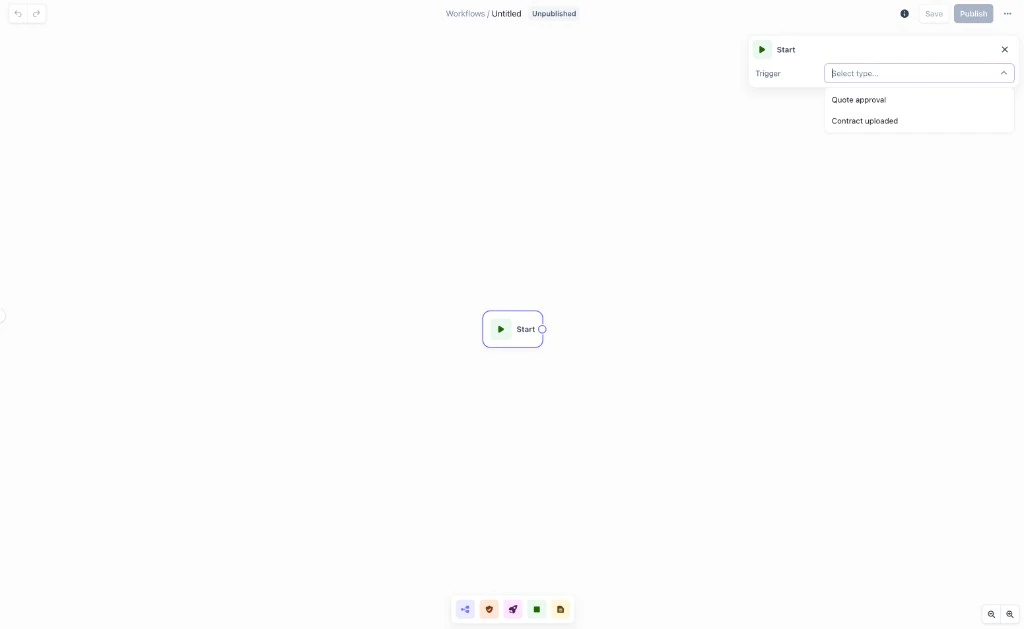
2
Add nodes and connect them
Use the toolbar at the bottom to add Switch, Review, Action, Reminder, End, and Note nodes. Connect them by dragging edges between nodes. Click any node to open its configuration panel. Save to preserve your draft; Publish when the workflow is ready to go live.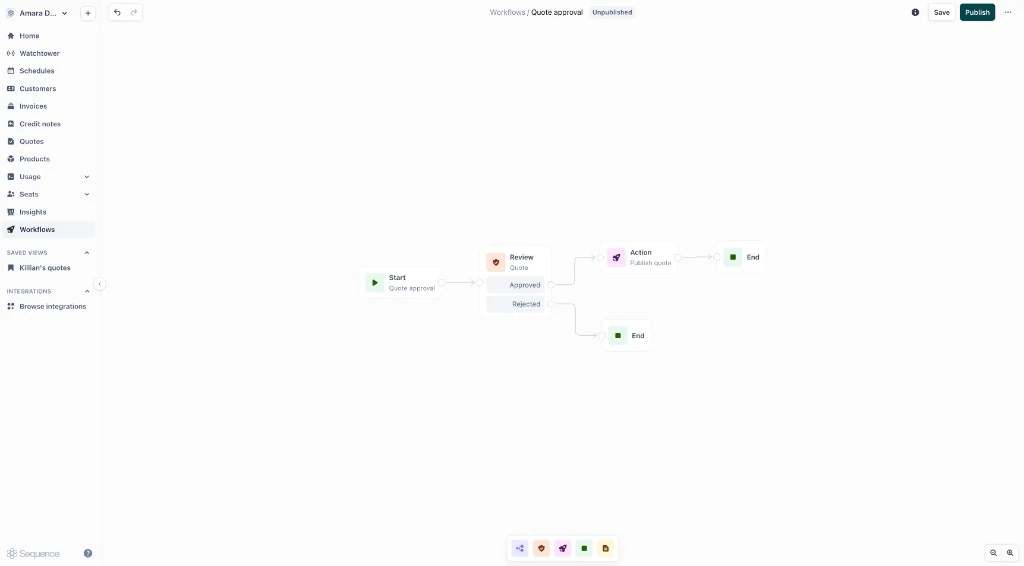
Node types
Switch node
The Switch node evaluates conditions against the quote or contract data and routes the run down the matching branch. Add branches with + and remove them with −. The final branch is always Else (catch-all for runs that do not match any condition). Each branch has one or more conditions; multiple conditions on a branch use AND logic.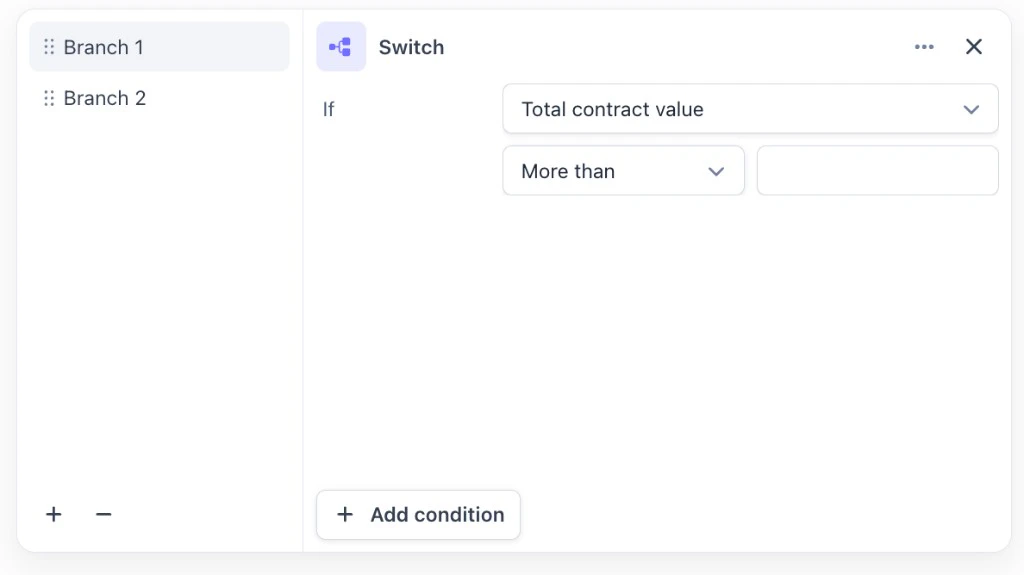
Choosing Product opens a second row to narrow further:
Contract uploaded workflows don’t currently expose Switch conditions on the trigger’s own data. Invoice sent workflows (used for payment reminders) use a smaller set instead:
Review node
The Review node pauses the workflow and creates a task in Watchtower assigned to the approvers you configure. The run holds until someone completes it. The node exposes Approved and Rejected output paths; connect each to the appropriate next step.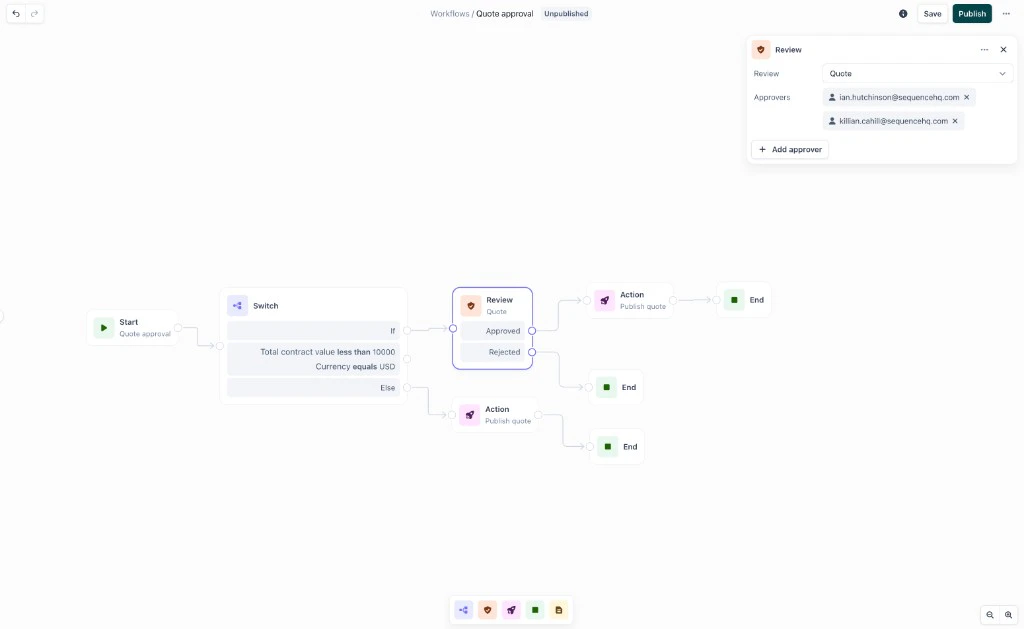
Action node
The Action node runs a Sequence operation when a condition is met or a review is approved. Available actions: Publish quote, Create schedule, Contract extraction.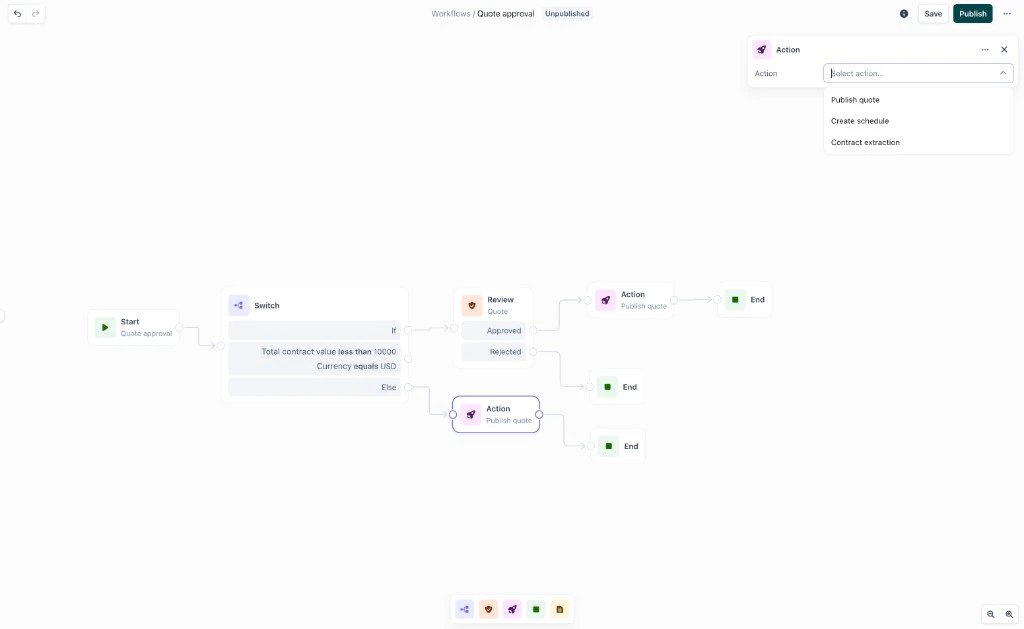
Reminder node
The Reminder node sends a payment reminder for an invoice. It packages a configurable wait, an invoice check, email composition, an optional review step, and the send into a single node. Chain several to build a dunning sequence. Use it with the Invoice sent trigger. See Payment reminders for full configuration (timing, template variables, approval, and webhooks).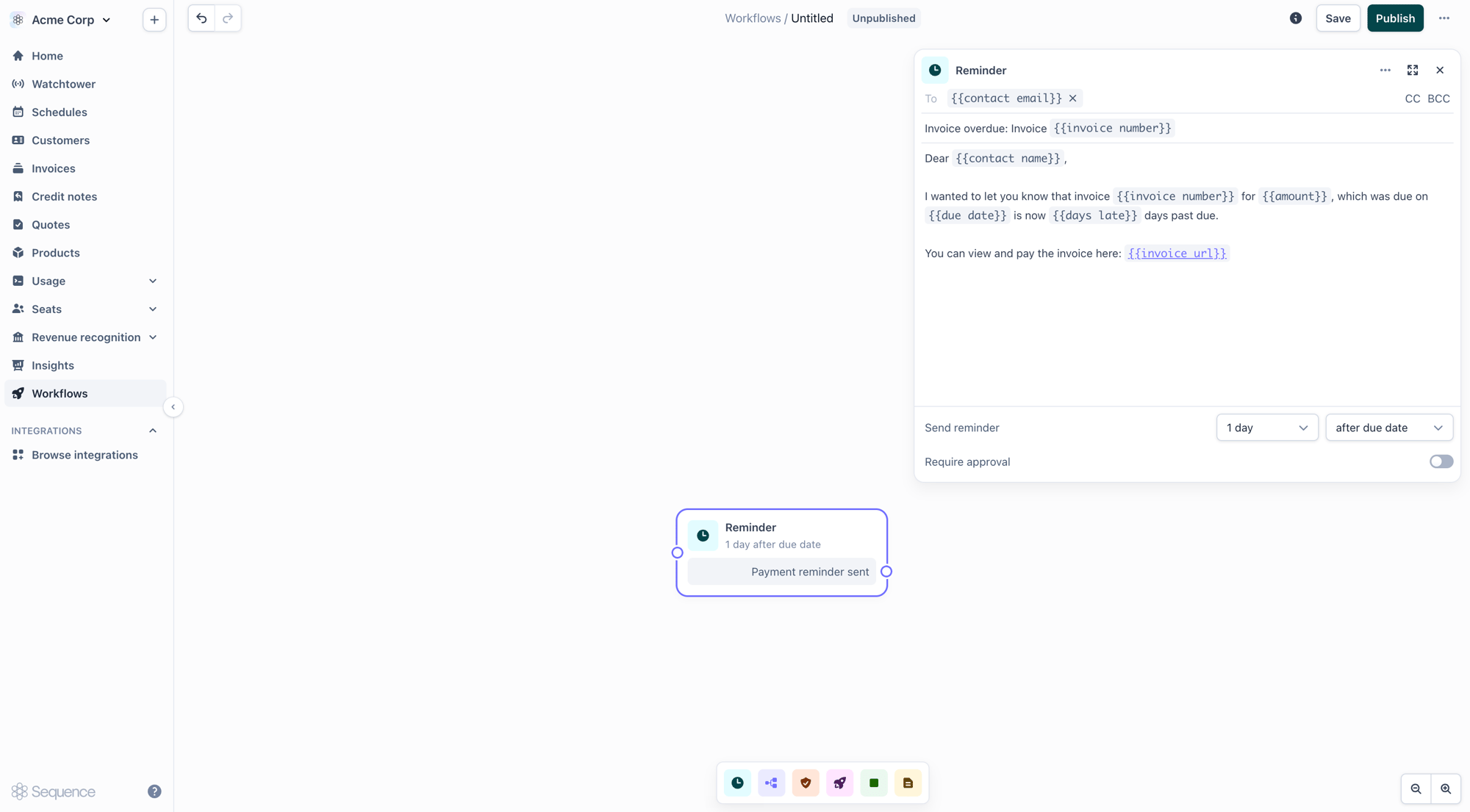
Note node
The Note node is a canvas annotation. It does not execute. Use it to explain branches, record policy decisions, or leave context for future editors.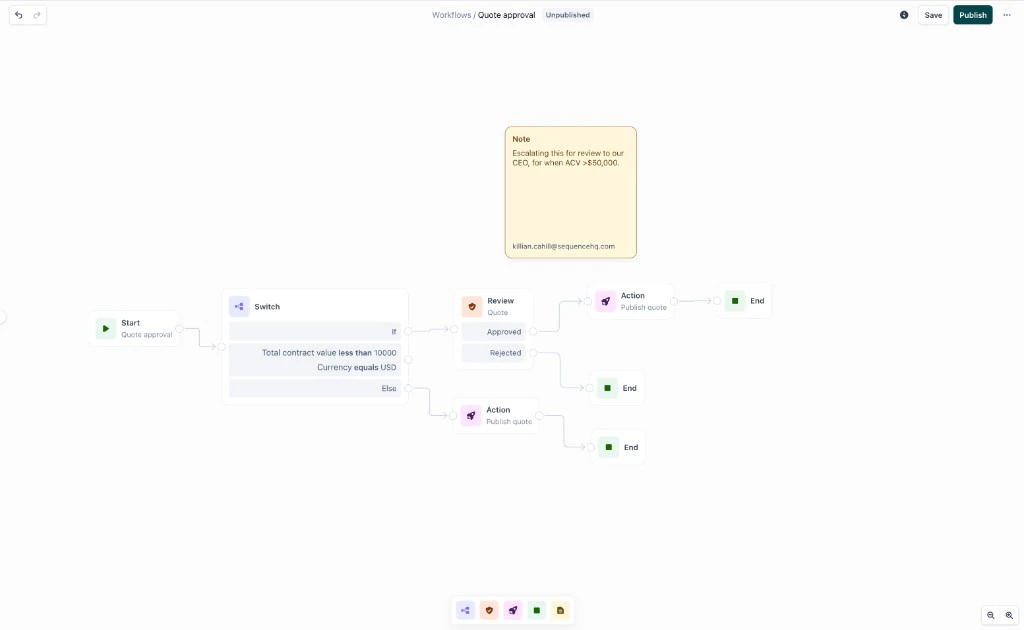
Publishing
Workflows start as drafts. Save and return as needed. When ready, Publish. The workflow then runs for every new trigger event. Version history records what was running at any point in time. Edit the draft and republish to update logic without interrupting in-flight runs. Only one workflow is active per trigger at a time. If you publish a workflow whose trigger is already used by another active workflow, the existing one is deactivated and yours takes its place, with no gap in coverage, and the confirmation names and links to the workflow being deactivated. You can keep as many draft workflows as you like for the same trigger.Quote approval flow
1
Quote submitted
A sales rep submits a quote for approval in Sequence. The request comment is captured and attached to the run.
2
Switch evaluates conditions
The workflow runs the Switch node against your conditions (deal size, discount, currency, products). The run takes the first matching branch.
3
Review task in Watchtower
The run pauses at the Review node. A task appears in Watchtower for the assigned approvers with the full quote, requestor details, and sales rep comment.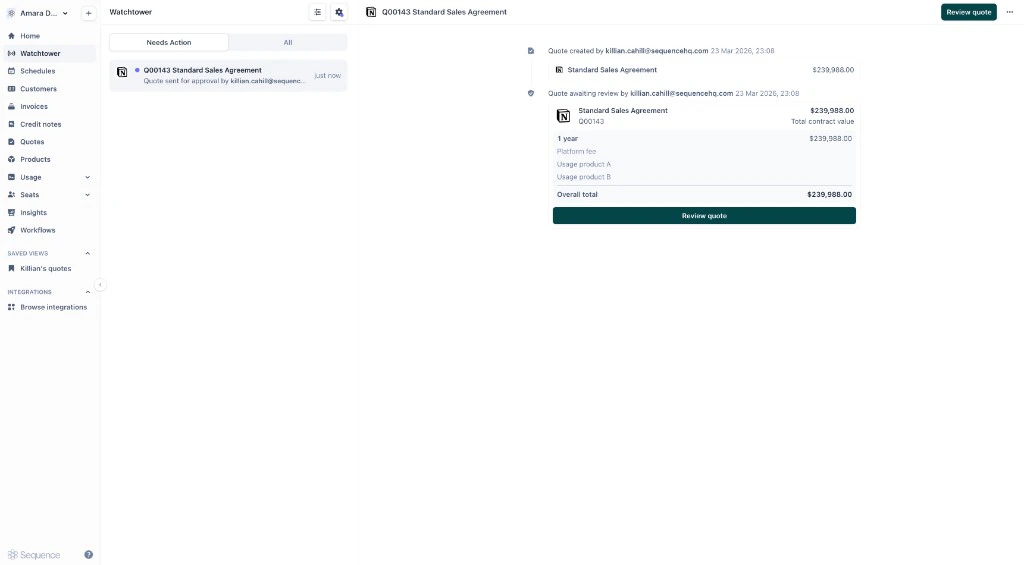
4
Approver decides
The approver opens the task in Watchtower and approves or rejects.
5
Action runs
On approval, the workflow continues to the Action node and publishes the quote (or executes the configured action).
Re-approvals
A quote is locked for editing while it has a pending review. Once the review resolves, whether approved or rejected, the lock lifts and the quote can be edited again. By default, every Publish, Publish changes, and Republish action sends the quote through the workflow again, regardless of whether an earlier version of the same quote was already approved. Edit an approved quote and republish it, and it goes back to the top of the flow: the Switch node evaluates conditions again and a new Review task is created. You don’t have to leave it there. Add a Previous approval condition to a Switch node to compare the quote against the version that was last approved at a specific Review node further downstream, and route around review when nothing material has changed, for example when someone only adds a recipient or tweaks the cover page.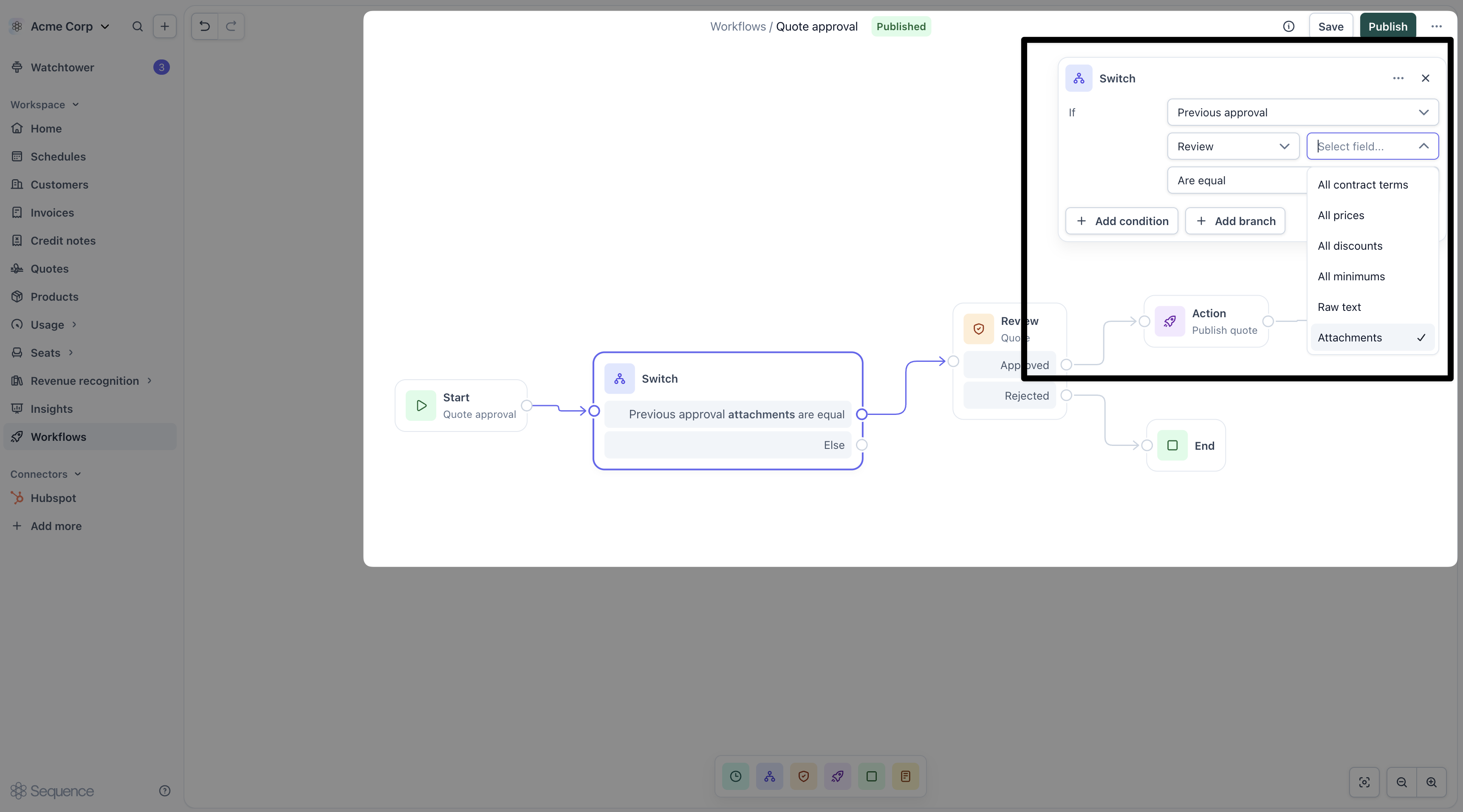
Add several Previous approval conditions on the same branch to gate on more than one field at once, for example: always re-review if prices changed, but let discount-only tweaks through without one.
If the quote has never been approved at the chosen review step, or its last attempt there was rejected, the comparison always reads as not equal. There’s no version to compare against, so it routes to review rather than silently skipping it.
Monitoring
All workflow runs are tracked in Watchtower. Visibility is role-based:
Enable Admin mode in Watchtower to see all tasks across your workspace. You can manually override and approve tasks from there. Cancel any in-progress run from Watchtower if a quote was submitted in error or needs to restart.
Permissions
Users assigned to a Review task can complete it; admins can complete any task, assigned or not. The quote requestor is excluded from approving their own request. See Review node for how contract reviews additionally restrict who can be assigned. Finer-grained approver roles for quote reviews are planned.Best practices
Map the full flow before building
Map the full flow before building
Sketch the happy path and edge cases first. Who approves what? What happens on rejection? Use Note nodes to capture decisions.
Model variation inside one workflow
Model variation inside one workflow
Only one workflow runs per trigger at a time, so model variation within a single workflow using Switch branches rather than relying on several workflows for the same trigger. Publishing a second workflow for a trigger deactivates the first.
Layer conditions precisely
Layer conditions precisely
Combine conditions on a branch (e.g. total contract value more than $50,000 and currency equals USD). Route the Else branch somewhere sensible.
Test every branch before publishing
Test every branch before publishing
Walk through each branch before going live. Confirm Approved and Rejected paths on every Review node lead somewhere meaningful.
Keep approver assignments current
Keep approver assignments current
Update the Review node when approvers change role or leave the team.
Related
- Approving a quote: what an approver sees and can do with a submitted quote
- Watchtower: review tasks, track runs, audit decisions
- Contract intake agent: end-to-end contract processing built on Workflows
- Payment reminders: automate invoice chasing (dunning) with Reminder nodes